

Melbourne families searching for affordable granny flat options inevitably discover flat pack granny flats advertised from $120,000 with promises of DIY assembly in “just 2-3 weeks.” The marketing sounds compelling until you understand why Melbourne councils reject approximately 60% of flat pack applications, and why true all-in costs typically reach $180,000-$200,000 once you account for everything actually required.
Understanding the reality behind flat pack marketing versus permanent construction helps you make informed decisions protecting both your investment and timeline. This guide exposes what flat pack suppliers don’t advertise prominently: the hidden costs, council rejection reasons, and why permanent builds often cost less when you account for everything.
What Flat Pack Granny Flats Actually Are
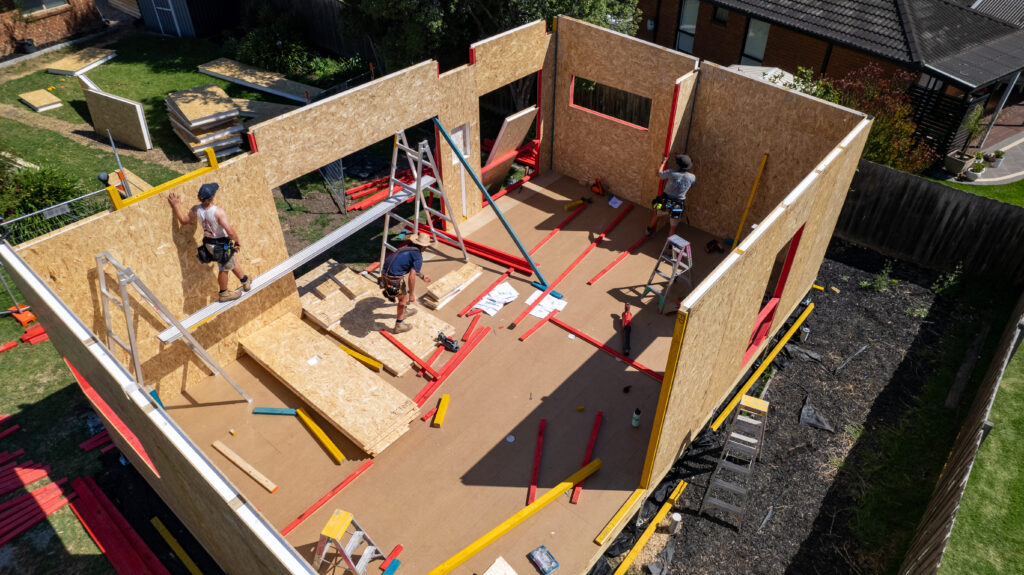
Flat pack granny flats arrive as pre-manufactured panels, frames, and components requiring on-site assembly. Think IKEA furniture scaled up to house-size, though that comparison insults IKEA’s instruction quality.
What’s typically included in base pricing:
- Wall panels (framed, sometimes insulated)
- Roof trusses or panels
- Window and door frames
- Basic framing materials
- Assembly instructions (quality varies dramatically)
What’s almost never included despite being essential:
- Foundation and slab ($15,000-$25,000)
- Electrical and plumbing ($12,000-$18,000)
- Council permits and engineering ($3,000-$6,000)
- Site preparation and crane hire ($4,000-$8,000)
- Interior fit-out (kitchen, bathroom) ($25,000-$40,000)
- External cladding and finishes ($8,000-$15,000)
The true cost reality: That $120,000 advertised flat pack becomes $187,000-$232,000 delivered, permitted, and habitable. Compare this to permanent construction starting at $190,000 fully complete with everything included.
Why Melbourne Councils Reject Flat Pack Applications

Council approval represents the biggest risk with flat pack granny flats. Understanding common rejection reasons helps you appreciate why permanent builds avoid these problems.
Engineering inadequacy for Melbourne soils: Flat pack designs assume stable ground conditions. Melbourne’s reactive clay soils require specific engineering for foundation movement. Generic flat pack engineering rarely satisfies Victorian building surveyors, resulting in expensive custom engineering or outright rejection.
Energy rating failures: Achieving Victoria’s mandatory 7-star energy rating requires specific insulation, glazing, and thermal performance. Many flat pack designs pre-date current standards or originate from interstate where different requirements apply. Modifications to meet Victorian standards often cost $8,000-$15,000.
Wind loading calculations: Melbourne experiences significant wind events. Flat pack designs from other climates may not meet Victorian wind loading requirements, particularly for coastal areas. Structural upgrades required for approval negate the supposed cost savings.
Non-compliant materials: Some flat pack systems use materials not approved under Victorian building codes. Replacing non-compliant components defeats the entire flat pack concept.
Assembly quality concerns: Building surveyors increasingly reject flat pack applications based on assembly track records. If previous flat pack builds in their municipality showed poor construction quality, they scrutinise new applications heavily.
According to consumer advocacy group Choice, flat pack housing complaints increased 240% between 2022-2024, primarily around structural adequacy and weather-proofing failures.
The Hidden Costs That Destroy Flat Pack Budgets
Even when councils approve flat pack applications, the assembly and completion costs shock people who believed marketing promises.
Professional assembly requirements: DIY assembly sounds feasible until you’re holding a 3.2-metre wall panel in 25km/h winds trying to bolt it to foundations whilst ensuring it’s perfectly plumb and square. Most families hire professional builders, costing $15,000-$30,000 for assembly alone.
Crane and equipment hire: Lifting heavy panels safely requires cranes or telehandlers. Hire costs $2,000-$4,000 depending on site access and assembly duration.
Trades coordination: Even with panels assembled, you still need licensed electricians, plumbers, and gas fitters. Flat pack systems don’t eliminate these costs; they just shift them from builders to you coordinating multiple independent tradies.
Rectification work: Assembly inevitably reveals problems: panels don’t align perfectly, holes don’t match, dimensions are slightly off. Professional builders spend 20-40 hours rectifying issues that shouldn’t exist in properly manufactured systems.
Weather delays: Unlike professional builds where trades work progressively inside weatherproof structures, flat pack assembly stops in rain. Melbourne’s unpredictable weather often doubles assembly timelines.
True timeline reality: The promised “2-3 week assembly” becomes 8-12 weeks accounting for weather delays, rectification work, trades coordination, and council inspections. Professional permanent builds average 16-20 weeks but include everything completed to move-in standard.
Quality Differences: Flat Pack vs Permanent Construction
Beyond costs and timelines, construction quality differences become apparent within the first year.
| Aspect | Flat Pack Reality | Permanent Build Standard |
|---|---|---|
| Insulation | Often gaps between panels | Continuous, professionally installed |
| Weatherproofing | Panel joints vulnerable to water | Integrated weather barriers |
| Acoustic performance | Poor sound transmission control | Proper acoustic insulation |
| Structural integrity | Bolted connections loosen over time | Engineered, permanent connections |
| Modifications later | Extremely difficult | Standard building modifications |
The weatherproofing problem: Flat pack systems rely on sealants and gaskets at panel joints to prevent water ingress. Melbourne’s temperature extremes cause sealants to degrade, creating leaks within 2-4 years. Permanent construction uses lapped weatherproofing that doesn’t depend on sealant integrity.
The acoustic reality: Bolted panel systems transmit sound more readily than permanent construction. For families with elderly parents or rental properties, this matters enormously. Nobody wants to hear every conversation, footstep, or television through walls.
The modification limitation: Want to add extra power points, move a wall, or install air conditioning later? Flat pack systems make modifications expensive because you’re working around pre-manufactured panels rather than standard framing. This inflexibility reduces long-term value.
When Flat Pack Might Make Sense (Rare Cases)
Despite overwhelming disadvantages, specific situations might justify flat pack consideration.
Temporary accommodation needs: If you need housing for 3-5 years then plan to remove it, flat pack’s easier disassembly provides value. However, council permits still require permanent foundations, limiting true portability.
Extremely remote locations: Where bringing permanent construction materials costs excessively due to access challenges, flat pack’s reduced transportation costs might offset other disadvantages. This rarely applies in Melbourne.
DIY enthusiasts with trade experience: Licensed builders or engineers with genuine skills and time can potentially save money through flat pack. However, most underestimate complexity and end up hiring help anyway.
Budget constraints under $150,000 total: If your absolute maximum budget is $150,000 all-in and you’re willing to accept quality compromises, flat pack might be your only option. However, finance options for permanent builds often prove more sensible than accepting inferior construction.
Why Permanent Construction Delivers Better Value
When you account for all costs honestly, permanent granny flat construction delivers superior value despite similar final costs.
True all-in pricing: Our $190,000-$255,000 packages include everything: permits, engineering, construction, appliances, landscaping, warranty. No hidden costs emerge mid-project.
Professional construction quality: Every element is built by licensed tradies following Victorian building codes precisely. This ensures compliance, quality, and long-term durability.
Weather-resistant assembly: Permanent construction proceeds in all weather conditions. Roofs go on quickly, protecting ongoing interior work from Melbourne’s unpredictable rain.
Shorter real timelines: Despite flat pack’s assembly promises, permanent builds complete faster when accounting for permit delays, rectification work, and weather interruptions.
Proper warranties: 10-year structural warranties protect permanent builds. Flat pack warranties often exclude problems caused during assembly, leaving you exposed.
Flexibility for modifications: Standard construction allows future modifications without specialised knowledge of proprietary systems.
Better resale value: When selling properties, quality permanent granny flats add $100,000-$180,000 to values. Flat pack constructions add considerably less due to perceived quality issues.
Questions To Ask Flat Pack Suppliers
If you’re still considering flat pack despite the warnings, these questions reveal whether suppliers are honest about true costs and limitations.
What’s the all-in cost including everything to completion? Honest suppliers provide detailed breakdowns including all trades, permits, and finishes. Evasive answers indicate they’re hiding costs.
Do you have council-approved projects in my Melbourne suburb? If they can’t show local approvals, assume rejection risk is high.
What’s included in your engineering? Generic engineering doesn’t work in Melbourne. Confirm site-specific engineering for your property’s soil conditions.
Who handles council liaison and permit applications? If they expect you to manage this, budget 3-6 months and considerable stress.
What happens if assembly reveals problems? Clarify who pays for rectification when panels don’t fit properly or quality issues emerge.
Your Next Steps To Smart Building Decisions
Flat pack granny flats promise affordability but rarely deliver on that promise once you account for reality. Understanding true costs and risks helps you make decisions protecting your investment.
Get comparable quotes: Contact Innovista Group for transparent permanent construction pricing. Compare genuine all-in costs rather than misleading advertised pricing versus our complete packages.
See quality differences firsthand: Book a free site assessment and visit completed permanent builds. The quality difference between flat pack and professional construction becomes immediately obvious.
Calculate true costs honestly: Include every expense required to reach habitable standard, not just initial flat pack purchase price.
Consider financing options: Investment-grade construction qualifies for better financing terms than flat pack projects banks view as risky.
Ready to build with confidence in quality, timeline, and value? Our permanent construction delivers custom-quality results at prices comparable to flat pack’s hidden-cost reality, backed by professional construction standards and genuine 10-year warranties protecting your investment.