
Here’s the good news about building granny flats in Melbourne: the Victorian Government has made it significantly easier since the December 2023 reforms. The better news? In 2026, the system is now well-established and streamlined. The challenge? Every council still has its own requirements that can catch you off guard if you’re not prepared.
Most Melbourne homeowners are pleasantly surprised to learn they don’t need a planning permit for granny flats in Melbourne under 60 square metres. But there’s still plenty to navigate, from setback requirements to building permits to council-specific rules that vary across Melbourne’s 31 local councils.
This comprehensive 2026 guide breaks down exactly what you need to know for your suburb, including updated timelines, costs, and council-by-council requirements for granny flats in Melbourne.
Melbourne’s Granny Flat Rules: The 2026 Framework Explained
The Victorian Government transformed granny flat regulations through Amendment VC253 in December 2023, and these changes are now fully operational across Melbourne in 2026. Here’s what this means for your project.
No Planning Permit Required If Your Granny Flat:
- Is 60 square metres or smaller in floor area
- Is built on a property 300m² or larger
- Meets standard setback requirements from boundaries
- Has no environmental overlays (heritage, flooding, bushfire zones)
- Is the only secondary dwelling on your property
- Meets ResCode standards (residential design code)
Building permits are always required regardless of size or planning exemption status. This ensures your granny flat meets safety standards, structural requirements, and building codes. Any structure over 10m² in Melbourne needs building approval.
What Councils Still Control In 2026
Even without planning permits, councils maintain authority over:
- Specific design requirements and materials
- Setback distances (minimum 1m side, 4m rear typically)
- Site coverage limits (usually 50-60% maximum)
- Privacy provisions and overlooking controls
- Tree protection and vegetation removal
- Compliance with 7-star energy rating (NCC 2022 mandatory)
Each Melbourne council interprets these requirements differently, which is why understanding your local council rules matters.
The Key 2026 Advantages
Speed: Building permits typically process in 3-6 weeks (2026 average), down from 8-12 weeks in previous years
Cost: Average permit costs $2,500-$4,000 (building only), compared to $8,000-$15,000 when planning permits were routinely required
Certainty: Standardised requirements across Victoria mean fewer surprises and faster approvals
Rental freedom: You can legally rent your granny flat to anyone, not just dependent family members
Melbourne Council Setback Requirements: 2026 Standards

Setback requirements determine where you can position your granny flats in Melbourne on your property. These rules ensure privacy, maintain neighbourhood character, and provide adequate outdoor space.
Standard Melbourne Setback Requirements (2026)
| Boundary | Minimum Setback | Notes |
|---|---|---|
| Rear boundary | 4 metres | From back fence to any part of building |
| Side boundaries | 1 metre | Each side (increases with building height) |
| Front boundary | Must be behind main house | Cannot be visible from street frontage in most councils |
| Height limit | 4.5 metres (single level) | Measured from natural ground level |
| Site coverage | 50-60% maximum | Combined main house + granny flat |
Height calculations for elevated structures:
- Buildings over 3.6m high require greater side setbacks (typically 1.5m-2m)
- Two-storey granny flats trigger additional privacy controls
- Sloping blocks measure height from lowest natural ground point
How Different Melbourne Councils Interpret Setbacks
Inner Melbourne councils (City of Melbourne, Yarra, Port Phillip, Stonnington):
- Often require 1.5-2m side setbacks (stricter than state minimum)
- Heritage overlays add 3-6 months to approvals
- Neighbourhood character assessments mandatory in established areas
- May require planning permits even for compliant designs
Eastern councils (Boroondara, Whitehorse, Manningham, Monash):
- Standard 1m side, 4m rear setbacks apply
- Strong emphasis on garden area preservation (minimum 30-40% unbuilt)
- Tree protection adds complexity (3m clearance zones common)
- Design must complement main dwelling architecture
Outer Melbourne councils (Casey, Cardinia, Whittlesea, Wyndham):
- Growth corridors actively support granny flats for investment
- Standard state requirements apply
- Faster processing (typically 3-4 weeks for building permits)
- Larger blocks mean setback compliance easier
Bayside councils (Bayside, Kingston, Frankston):
- Flood overlays common (check Melbourne Water flood maps)
- May require elevated floor levels ($8,000-$15,000 extra cost)
- Coastal character provisions in some areas
- Standard setbacks apply where no overlays exist
Special Setback Considerations (2026 Updates)
Easements:
- You cannot build within utility easements (common on rear boundaries)
- 1m clearance typically required either side of easements
- Check your Certificate of Title for easement locations
Mature trees:
- Protected trees require 3-5m clearance zones
- Removal permits rarely granted for granny flat construction
- Tree protection costs $1,500-$5,000 in consultant reports
Neighbouring windows:
- 3m setback from habitable room windows on neighbouring properties
- Alternative: Use obscure glazing or high sills (1.7m+)
- Balconies/decks require 9m setback from neighbouring windows
Slope and drainage:
- Properties over 10% slope require engineer-certified retaining walls
- Drainage plans mandatory for all applications
- Costs: $2,000-$8,000 additional for sloping sites
Pro tip: Measure from boundary pegs, not fences. Fences are often 100-300mm inside the actual boundary, and building based on fence lines causes expensive compliance issues.
Building Permits vs Council Approval: Melbourne’s 2026 Process
Understanding the difference between permit types saves time, money, and frustration.
Building Permits (Always Required)
Building permits focus on:
- Structural integrity and foundation requirements
- Fire safety and emergency access provisions
- 7-star energy efficiency (mandatory 2026)
- Livable Housing Design Standards (NCC 2022)
- Electrical and plumbing compliance
- Disability access where required
Processing time (2026 averages):
- Private building surveyor: 2-3 weeks ($2,500-$3,500)
- Council building surveyor: 4-6 weeks ($1,800-$2,800)
Required documentation:
- Architectural drawings (elevations, floor plans, site plan)
- Energy rating report (NatHERS 7-star)
- Engineering assessment (soil, structural)
- Compliance certificates (plumbing, electrical)
Planning Permits (Only When Required)
You still need planning permits for granny flats in Melbourne when:
- Granny flat exceeds 60m²
- Property has heritage overlay (check here)
- Site has bushfire management overlay
- Flood overlay applies (common in Maribyrnong, Yarra areas)
- Design doesn’t meet standard setbacks
- Property has environmental significance overlay
- Tree removal required for construction
Processing time: 6-12 weeks plus neighbour notification period (14 days)
Additional costs: $2,500-$6,000 in application fees and consultant reports
The 2026 Building Permit Process
Step 1: Engage building surveyor (Week 0)
- Choose private (faster) or council (cheaper)
- Provide preliminary site plans
- Discuss any site-specific challenges
Step 2: Prepare documentation (Weeks 1-2)
- Architectural plans finalised
- Energy rating completed
- Engineering assessments conducted
- Compliance documentation assembled
Step 3: Application lodgement (Week 2)
- Submit complete application package
- Pay application fees
- Surveyor conducts preliminary review
Step 4: Assessment period (Weeks 3-5)
- Building surveyor reviews compliance
- May request additional information
- Site inspection if required
Step 5: Permit issued (Week 5-6)
- Building permit issued electronically
- Valid for 2 years from issue date
- Construction can commence
Total timeline: 5-6 weeks for standard builds without complications
Melbourne Suburb-By-Suburb Granny Flat Requirements (2026 Guide)
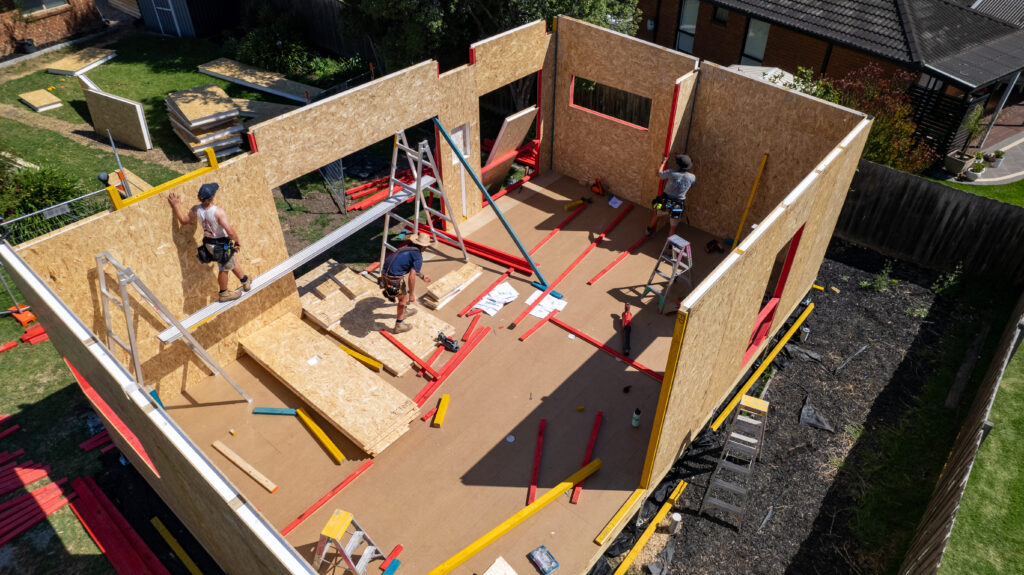
Different Melbourne councils have developed unique approaches to granny flat regulations. Here’s your definitive council-by-council guide for 2026:
Inner Melbourne (Stricter Requirements)
Melbourne City Council
- Planning permit required: Yes, for most heritage areas
- Typical timeline: 10-14 weeks (includes planning)
- Setbacks: 1.5m side, 4m rear minimum
- Special requirements: Heritage assessments ($2,000-$5,000), design quality reviews
- Best for: Custom granny flats with architectural merit
- Average approval cost: $8,000-$15,000
Yarra City Council
- Planning permit required: Often (extensive heritage overlays)
- Typical timeline: 12-16 weeks
- Setbacks: 2m side, 5m rear in heritage areas
- Special requirements: Neighbourhood character reports mandatory
- Challenges: Tree protection common, small block sizes
- Average approval cost: $10,000-$18,000
Port Phillip City Council
- Planning permit required: Frequently (heritage and coastal areas)
- Typical timeline: 10-12 weeks
- Setbacks: 1.5m side, 4m rear
- Special requirements: Sustainable design emphasis, coastal overlay considerations
- Best for: Investment properties in St Kilda, Elwood areas
- Average approval cost: $7,000-$14,000
Stonnington City Council
- Planning permit required: Common in Toorak, South Yarra heritage areas
- Typical timeline: 10-14 weeks
- Setbacks: 2m side, 5m rear in heritage zones
- Special requirements: High design standards, heritage compliance
- Average approval cost: $9,000-$16,000
Eastern Melbourne (Neighbourhood Character Focus)
Boroondara City Council
- Planning permit required: Rarely (if under 60m² and no overlays)
- Typical timeline: 4-6 weeks (building permit only)
- Setbacks: 1m side, 4m rear (standard)
- Special requirements: Must complement main dwelling style, garden area preservation (35% minimum)
- Popular suburbs: Kew, Camberwell, Hawthorn
- Average approval cost: $4,000-$7,000
Whitehorse City Council
- Planning permit required: Rarely
- Typical timeline: 4-5 weeks
- Setbacks: 1m side, 4m rear
- Special requirements: Family-friendly design emphasis, privacy screening
- Popular suburbs: Box Hill, Mitcham, Blackburn
- Average approval cost: $3,500-$6,000
Manningham City Council
- Planning permit required: Sometimes (heritage areas in Doncaster, Templestowe)
- Typical timeline: 5-7 weeks
- Setbacks: 1m side, 4m rear, additional for sloping blocks
- Special requirements: Slope and drainage management, bushfire overlay in some areas
- Average approval cost: $4,500-$8,000
Monash City Council
- Planning permit required: Rarely
- Typical timeline: 4-6 weeks
- Setbacks: 1m side, 4m rear
- Special requirements: Standard ResCode compliance, neighbourhood character in established areas
- Popular suburbs: Glen Waverley, Mount Waverley, Clayton
- Average approval cost: $3,800-$6,500
Knox City Council
- Planning permit required: Rarely (except bushland areas)
- Typical timeline: 3-5 weeks
- Setbacks: 1m side, 4m rear
- Special requirements: Environmental protection in bushland, supportive of multigenerational living
- Average approval cost: $3,500-$5,500
Outer Melbourne (Growth-Friendly Approach)
Casey City Council
- Planning permit required: Rarely
- Typical timeline: 3-4 weeks (fastest in Melbourne)
- Setbacks: 1m side, 4m rear
- Special requirements: Standard state requirements, streamlined for growth areas
- Popular suburbs: Cranbourne, Clyde North, Pakenham
- Investment appeal: High rental demand ($500-$550/week)
- Average approval cost: $3,000-$5,000
Cardinia Shire Council
- Planning permit required: Depends on zone (rural vs residential)
- Typical timeline: 4-6 weeks
- Setbacks: 1m side, 4m rear (residential); larger in rural zones
- Special requirements: Rural worker accommodation provisions, larger blocks
- Popular areas: Officer, Pakenham, Beaconsfield
- Average approval cost: $3,500-$6,000
Wyndham City Council
- Planning permit required: Rarely
- Typical timeline: 3-5 weeks
- Setbacks: 1m side, 4m rear
- Special requirements: Supportive policies, fast processing
- Popular suburbs: Werribee, Point Cook, Tarneit
- Investment appeal: Strong growth, high rental yields
- Average approval cost: $3,200-$5,500
Whittlesea City Council
- Planning permit required: Rarely
- Typical timeline: 4-5 weeks
- Setbacks: 1m side, 4m rear
- Special requirements: Growth corridor support, new estate provisions
- Popular suburbs: Mernda, Doreen, South Morang
- Average approval cost: $3,500-$5,800
Melton City Council
- Planning permit required: Rarely
- Typical timeline: 4-6 weeks
- Setbacks: 1m side, 4m rear
- Special requirements: Standard compliance, developing area
- Investment appeal: Affordable builds, growing rental market
- Average approval cost: $3,200-$5,200
Bayside Melbourne (Flood & Heritage Considerations)
Bayside City Council
- Planning permit required: Sometimes (flood overlays common)
- Typical timeline: 6-8 weeks (if flood reports needed)
- Setbacks: 1.5m side, 4m rear
- Special requirements: Flood assessments, elevated floor levels in some areas
- Popular suburbs: Brighton, Hampton, Sandringham
- Average approval cost: $5,000-$9,000 (higher with flood reports)
Kingston City Council
- Planning permit required: Sometimes (coastal areas)
- Typical timeline: 5-7 weeks
- Setbacks: 1m side, 4m rear (standard areas)
- Special requirements: Coastal character provisions, flood overlays in some areas
- Average approval cost: $4,000-$7,500
Frankston City Council
- Planning permit required: Rarely
- Typical timeline: 4-6 weeks
- Setbacks: 1m side, 4m rear
- Special requirements: Some coastal and environmental overlays
- Investment appeal: Affordable builds, growing area
- Average approval cost: $3,500-$6,000
Pattern summary: Inner councils = stricter + slower (10-14 weeks, $8k-$18k). Eastern councils = moderate (4-6 weeks, $4k-$8k). Outer councils = fastest + cheapest (3-5 weeks, $3k-$6k).
Property Red Flags That Complicate Granny Flats In Melbourne Approvals
Before getting excited about your granny flat investment, check your property for these common issues that complicate or prevent approvals.
1. Easements (50% of Melbourne properties affected)
What they are: Utility corridors for sewerage, electricity, gas, or drainage
Impact: You cannot build within easement areas (typically 1-3m wide)
Common locations:
- Rear boundaries (sewerage easements)
- Side boundaries (drainage easements)
- Internally on older subdivisions
How to check: Your Certificate of Title shows all registered easements
Workaround: Position granny flat to avoid easement areas, or apply for easement relocation ($5,000-$15,000 if approved)
2. Flood Overlays (25% of Melbourne properties)
Affected areas:
- Maribyrnong River corridor
- Yarra River and tributaries
- Bayside low-lying areas
- Dandenong Creek catchments
Impact:
- Requires flood risk assessment ($2,000-$4,000)
- May mandate elevated floor levels (adds $8,000-$15,000 to build cost)
- Some areas prohibit new dwellings in flood zones
How to check: Melbourne Water flood mapping or council planning maps
3. Heritage Overlays (35% of inner Melbourne)
Most affected councils: Melbourne City, Yarra, Port Phillip, Stonnington, Boroondara
Impact:
- Requires planning permit (6-12 weeks extra)
- Heritage reports mandatory ($2,000-$5,000)
- Design must complement heritage character
- May prohibit granny flats in some heritage areas
How to check: Heritage Victoria database or council planning schemes
4. Covenant Restrictions (15% of properties, especially newer estates)
Common restrictions:
- “Single dwelling only” clauses
- Minimum setback requirements beyond council standards
- Architectural style requirements
- Prohibition on secondary dwellings
Impact: Covenants override council planning permissions
How to check: Certificate of Title or property purchase contract
Workaround: Some covenants expire after 10-15 years; seek legal advice
5. Tree Protection Orders (20% of established suburbs)
Affected trees:
- Significant trees over 8m height
- Heritage-listed trees
- Vegetation protection overlay trees
- Trees within 3m of property boundaries
Impact:
- 3-5m clearance zones required
- Removal rarely permitted
- May force alternative granny flat positioning
Cost of reports: $1,500-$5,000 for arborist assessments
6. Bushfire Management Overlays
Affected areas:
- Hillside suburbs (Eltham, Warrandyte, Hurstbridge)
- Some outer Melbourne areas (Narre Warren North, Kinglake)
Impact:
- Requires bushfire attack level (BAL) assessment
- Special construction standards (adds 10-15% to build cost)
- May limit design options
How to identify early: Order a Section 32 statement from your council showing all overlays, easements, and restrictions. Cost: $50-$150
Common Melbourne Granny Flat Application Rejection Reasons (2026 Data)
Learning from others’ mistakes saves time and money. Here are the most frequent reasons councils reject granny flat applications in 2026:
Rejection Reason #1: Setback Violations (38% of rejections)
The mistake: Measuring from fences instead of actual boundary lines, or failing to account for easements
The consequence: Application rejected, redesign required ($2,000-$5,000), 6-8 week delay
How to avoid:
- Get professional survey showing exact boundaries ($600-$1,200)
- Measure from boundary pegs, not fences
- Account for easements in calculations
- Add 100mm buffer beyond minimum setbacks
Rejection Reason #2: Site Coverage Exceedance (28% of rejections)
The mistake: Not calculating existing house footprint before proposing granny flat
Typical limits: 50-60% of total property area (varies by council and zone)
How to avoid:
- Calculate main house footprint including carport, pergolas
- Add proposed granny flat area
- Ensure total stays within council maximum
- Include all covered areas in calculations
Rejection Reason #3: Missing 7-Star Energy Rating (18% of rejections)
The requirement: All new dwellings must achieve 7-star NatHERS rating (mandatory since October 2023)
The consequence: Application returned, $400-$800 to obtain rating, 2-3 week delay
How to avoid:
- Engage NatHERS assessor during design phase
- Design with energy efficiency from start (double glazing, insulation, orientation)
- Budget for energy report in upfront costs
Rejection Reason #4: Privacy/Overlooking Non-Compliance (12% of rejections)
The issue: Windows directly overlooking neighbouring habitable rooms or private outdoor spaces
Council requirements:
- 3m setback from neighbouring windows
- 9m setback from neighbouring balconies/decks
- OR use obscure glazing and high sills (1.7m+)
How to avoid:
- Consider neighbouring property layout when designing
- Use frosted glass where necessary
- Position outdoor living areas away from boundaries
- Add privacy screens to decks
Rejection Reason #5: Incomplete Documentation (4% of rejections)
Common missing items:
- Engineering reports
- Site survey
- Energy rating certificate
- Stormwater management plan
- Electrical and plumbing compliance
How to avoid: Use experienced professionals who understand your council’s specific requirements
Cost Breakdown: Melbourne Granny Flat Permits (2026 Pricing)
Accurate budgeting prevents surprises. Here’s the complete breakdown:
Building Permit Only (Standard Scenario)
| Cost Item | Price Range (2026) |
|---|---|
| Private building surveyor | $2,500-$3,500 |
| Council building surveyor | $1,800-$2,800 |
| Engineering reports (soil, structural) | $1,200-$2,200 |
| NatHERS energy rating (7-star) | $400-$800 |
| Site survey | $600-$1,200 |
| Architectural plans | $2,000-$4,000 |
| Total (building permit only) | $8,500-$14,500 |
Planning Permit Required (Heritage/Overlay Scenario)
| Additional Cost Item | Price Range |
|---|---|
| Planning application fee | $1,500-$3,500 |
| Planning consultant | $2,500-$5,000 |
| Heritage assessment | $2,000-$5,000 |
| Neighbour notification | $500-$1,000 |
| Additional total | $6,500-$14,500 |
| Combined total (both permits) | $15,000-$29,000 |
Complex Site Scenarios (2026)
Sloping block (>10% grade):
- Retaining wall engineering: $2,000-$4,000
- Additional earthworks: $8,000-$20,000
Flood overlay:
- Flood risk assessment: $2,000-$4,000
- Elevated floor construction: +$8,000-$15,000
Bushfire overlay:
- BAL assessment: $1,500-$3,000
- Special construction requirements: +10-15% build cost
Tree protection:
- Arborist report: $1,500-$5,000
- Tree protection measures during construction: $2,000-$8,000
Smart approach: Invest $500-$1,000 in preliminary professional advice before committing to projects. This consultation can save $10,000+ in avoided mistakes.
How Innovista Simplifies Melbourne’s Council Approval Process

Navigating Melbourne’s 31 different councils shouldn’t be stressful. Every council has unique timing, requirements, and interpretation of rules, but that’s exactly why working with experienced professionals makes such a difference.
What Innovista Handles For You
Complete approval management:
- All council applications and documentation
- Building surveyor coordination
- Engineering and energy assessments
- Site surveys and boundary verification
- Compliance documentation assembly
Council-specific expertise:
- We’ve successfully handled approvals across all Melbourne councils
- We know each council’s specific preferences and requirements
- We submit applications that align with council expectations
- We prevent the delays that happen with incomplete applications
Transparent timeline management:
- Clear milestones for each approval stage
- Regular updates on application progress
- Proactive management of any council queries
- No surprises or hidden delays
Our 2026 Melbourne Track Record
Average approval times:
- Outer Melbourne councils: 3-4 weeks
- Eastern Melbourne councils: 4-6 weeks
- Inner Melbourne councils: 6-8 weeks (building only)
Success rate: 98% first-time approval (industry average: 75%)
Cost certainty: Fixed-price packages include all approval costs
Why Melbourne Families Choose Innovista
Experience across all Melbourne councils:
- From heritage-protected Toorak to growth-corridor Cranbourne
- From bayside Brighton to outer-suburban Pakenham
- We understand each council’s unique interpretation of rules
Comprehensive service:
- No surprise permit costs or lengthy delays
- Approval process kept transparent
- You understand what’s happening at every stage
Quality-focused approach:
- All-inclusive packages meet all compliance requirements
- Designs optimised for council approval
- Built to 7-star energy standards and NCC 2022
Investment support:
- Optimised for rental income potential
- Designed for fastest approvals and quickest returns
- Tenant-ready specifications from day one
Ready To Get Your Melbourne Granny Flat Approved?
Don’t navigate Melbourne’s 31 councils alone. With 2026’s streamlined regulations and Innovista’s expertise, getting approved is faster and easier than ever.
Next steps:
- Book your free site assessment – We’ll identify any potential approval challenges specific to your property and council
- Receive council-specific advice – Get a clear timeline and cost estimate for your suburb’s requirements
- Let us handle the approvals – We manage all council applications, documentation, and compliance
- Start building sooner – With approvals handled professionally, you move faster to construction and rental income
Contact Innovista Group today and let our experienced team handle all Melbourne council requirements while you focus on planning your investment returns.
Popular Melbourne suburbs we serve: Cranbourne, Clyde North, Pakenham, Werribee, Point Cook, Tarneit, Officer, Berwick, Frankston, Dandenong, Glen Waverley, Box Hill, and all Melbourne metro areas within 50-150km of CBD.
From approvals to construction, we make building granny flats in Melbourne straightforward, compliant, and profitable in 2026.


