
Last updated October 2026
Prefabricated granny flats in Melbourne are built partly or mostly away from your block, then delivered and finished on site. They sit alongside modular, kit and traditional site-built options, and each approach suits different blocks, budgets and buyers. This guide explains how each method works in plain terms, what every option still needs in Victoria, and the questions to ask before you sign anything.
Key takeaways
- Prefab, modular, kit and site-built granny flats all need a building permit in Victoria.
- Delivery trucks and cranes need clear access, so check your street, driveway and backyard early.
- Compare what is included, not just the headline price, because some quotes leave out site works and connections.
- Check that your builder is registered with the Building and Plumbing Commission and that the right insurance applies.
- Every G-Flat™ is a turnkey 60m², two bedroom build with a fixed price for each finish level.
What are prefabricated granny flats?
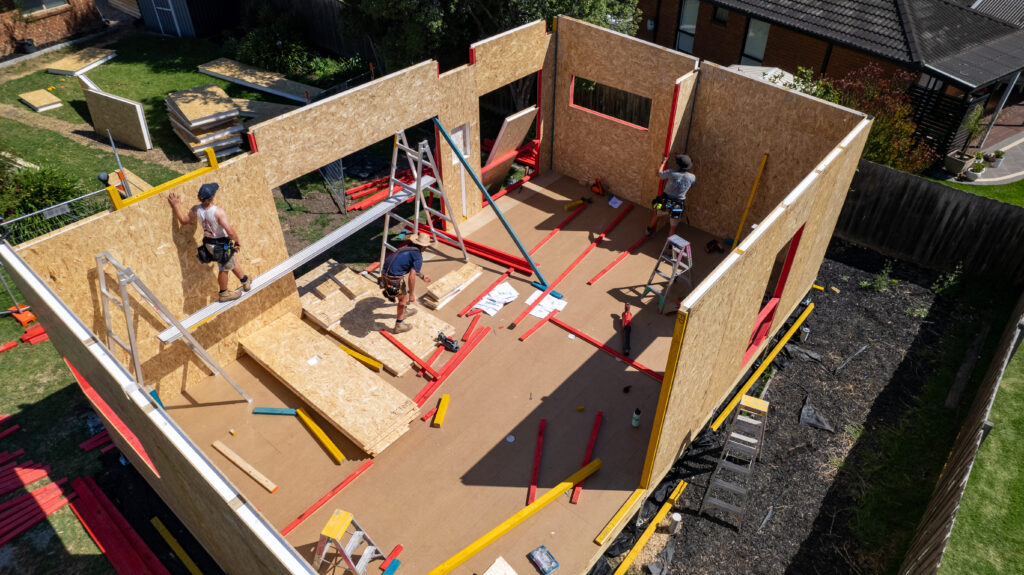
“Prefabricated” simply means some parts of the home are made before they reach your property. That can be as small as pre-cut wall frames and roof trusses, or as large as whole rooms built and fitted out elsewhere. Once the parts arrive, they are placed on footings, joined, connected to services and finished.
In Victoria, a granny flat of 60m² or less on the same lot as an existing home is called a small second dwelling. It must have its own kitchen, bathroom and toilet. The rules are the same however the home is built, so prefabricated granny flats in Melbourne follow the same approval path as any other granny flat.
Four ways a granny flat can be built
Most options on the market fall into one of four broad groups. The labels are used loosely, so ask each supplier exactly what their method involves.
| Approach | What it generally means | What arrives on site | Key things to check |
|---|---|---|---|
| Prefab (panelised) | Wall, floor or roof panels made elsewhere | Panels and frames for assembly | Who assembles it, and what finishing work is left |
| Modular | Whole sections or rooms made elsewhere | Large finished modules | Truck and crane access, joins between modules |
| Kit or flat pack | Materials supplied, often pre-cut | Bundled materials | Who builds it, permits, trades and insurance |
| Site-built | Built on your block from the slab or stumps up | Materials and trades over the build | Builder registration, timeline and inclusions |
Prefab and panelised builds
Panels are made to measure, then assembled on footings at your property. Plumbing, electrical, waterproofing and internal finishes are usually completed on site. Ask how much of the work happens after delivery, because that affects how long your backyard is a worksite.
Modular builds
Modular homes arrive in large sections that are lifted into place. Because each section is big, access becomes one of the most important checks. Our comparison of modular homes in Melbourne vs fixed granny flats looks at this in more depth.
Kit and flat pack granny flats
A kit supplies the materials, and you or your trades put it together. What each kit supplies varies, so check exactly which parts are included. If you are weighing this route, read flat pack granny flats in Melbourne and our granny flat kit homes guide first.
Site-built granny flats
A site-built home is constructed in your backyard by a builder and their trades. It can suit tight or irregular blocks where large deliveries are difficult. Work happens in stages, so ask how the builder will manage access, deliveries and noise around your household during construction.
Prefabricated granny flats in Melbourne still need approvals
Whatever the method, the home must be approved before it goes in. Under Victoria’s small second dwelling rules:
- a building permit is required for every small second dwelling
- no planning permit is needed in most residential zones
- lots under 300m² and some overlays (such as heritage, bushfire or flood) may need a planning permit
- the granny flat cannot be subdivided or sold separately from the main home
- it cannot connect to reticulated gas
- no extra car park is required
The Victorian Government small second dwellings page sets out the official rules. Our guide to granny flat approvals in Victoria walks through the process step by step.
A building permit is not just paperwork. It confirms the design meets the building regulations, including energy efficiency, fire safety and structural requirements. Ask any supplier of prefabricated granny flats in Melbourne whether the permit, plans and reports are included in their price.
Site access, transport and crane checks
Delivery is a key planning step for prefab and modular projects. Before you commit, check:
- Street access: can a truck park and unload safely, and are there overhead power lines or trees in the way?
- Crane space: is there room for a crane, and will it need to reach over the main house?
- Side access: how wide is the gap beside your home, and are there fences, sheds or gates to remove?
- Ground conditions: slope, soil type and drainage affect the footings and the cost of preparing the site.
- Existing trees: some trees are protected and cannot simply be removed. See what happens to existing trees on your block.
Our guide to what makes a block suitable for a granny flat covers the wider site checklist.
What to check in the inclusions
Two quotes for prefabricated granny flats in Melbourne can look similar and include very different things. Ask for a written list that covers:
- footings, slab or stumps
- the building permit, plans and engineering reports
- delivery, craneage and installation
- connection of water, sewer, stormwater and electricity, and how far the allowance runs
- kitchen, bathroom and laundry fit-out, including appliance brands
- flooring, window type and insulation
- heating and cooling
- decking, steps or landings
Anything not listed may become an extra cost later. Our guide to granny flat inclusions in Melbourne explains what each item means.
Warranty, insurance and a registered builder
The way a home is made does not change your protections. In Victoria:
- Builders must be registered with the Building and Plumbing Commission (BPC) to carry out domestic building work worth more than $10,000. Consumer Affairs Victoria explains how to check a builder’s registration.
- From 1 July 2026, Home Warranty insurance through the BPC replaced Domestic Building Insurance for new domestic building work over $20,000.
Ask who holds the building contract, who is the registered builder responsible for the work on your block, and what structural warranty applies. Our guide to choosing granny flat builders in Melbourne lists more questions to ask.
Questions to ask about prefabricated granny flats in Melbourne
Before you sign with any supplier, ask these questions and get the answers in writing:
- Is the price turnkey, or are site works, delivery and connections extra?
- Who applies for the building permit?
- Has my site been inspected for access and ground conditions?
- Who is the registered builder, and what insurance applies?
- What warranty covers the structure, and for how long?
- What is the timeline from contract to handover, including approvals?
Clear written answers make it much easier to compare prefabricated granny flats in Melbourne with any other option. If you are also weighing materials, see prefabricated granny flats vs brick.
Where the G-Flat™ fits
Every G-Flat™ is a turnkey 60m², two bedroom build. You choose one of five floor plans and one of four finish levels, and the price covers the home ready to move in. Every G-Flat™ includes:
- the building permit and all required reports
- all plans
- connection of services up to 10m from the main house
- stone benchtops and soft-close cabinetry
- SPC hybrid flooring
- double-glazed, powder-coated aluminium windows
- Colorbond fascia and guttering
- a reverse cycle split system
- a 10-year structural warranty and a 6-month maintenance guarantee
| Finish level | Turnkey price |
|---|---|
| Affordable | $198,000 |
| Homestead | $208,000 |
| Signature | $238,000 |
| Luxe | $265,000 |
Prices are a guide only and depend on your site. Sites 70km or more from the Melbourne CBD attract a 12.5% regional surcharge. A free site assessment confirms the price for your block.
All five plans (Stella, Aurora, Lana, Lana 2 and Sirius) cost the same within a finish level. See granny flat pricing in Victoria for the full breakdown, or 60m² granny flat designs for how the space is used.
How long it takes
Timelines for any granny flat depend on approvals, site preparation and service connections as much as construction. A G-Flat™ takes approximately 5 months end to end, from planning through to handover, including the building permit, construction and connection of services.
Frequently asked questions
Do prefabricated granny flats in Melbourne need a building permit?
Yes. Every small second dwelling in Victoria needs a building permit, however it is built.
Do I need a planning permit for a prefab granny flat?
Not in most residential zones if it is 60m² or less. Lots under 300m² and some overlays may need one.
Can a crane or truck reach my backyard?
It depends on your street, side access and overhead obstacles. A site inspection should confirm this before you sign.
Is a kit granny flat the same as a turnkey build?
No. A kit usually supplies materials, while a turnkey build covers the finished home ready to live in.
What does a G-Flat™ cost?
$198,000 to $265,000 turnkey, depending on the finish level and your site.
Compare your options with confidence
The right build method depends on your block, your access and what you want included. Book your free site assessment or visit our display G-Flat™.