

You’re looking at your backyard thinking “we need more space,” and suddenly you’re drowning in confusing terms. Kit homes. Modular homes. Prefab homes. Granny flats. Pod homes.
Are they all the same? Completely different? Does anyone actually know?
Let’s cut through the jargon and figure out what you’re actually buying.
The Quick Answer (Because You’re Busy)
Kit Homes = IKEA furniture but make it a house. You get pre-cut pieces, you (or a builder) assemble everything on-site.
Modular Homes = Built 80-90% complete in a factory, trucked to your place, craned into position. Done in days.
Granny Flats = Not a building method. It’s a TYPE of dwelling. A self-contained living space on your property. Can be built using kit, modular, or traditional methods.
Pod Homes = Mostly a marketing term for small, stylish modular buildings. Think backyard office or studio.
Still confused? Yeah, fair enough. Let’s break it down properly.
The Head-to-Head Comparison
| Feature | Kit Homes | Modular Homes | Granny Flats | Pod Homes |
| What arrives | Pre-cut materials in boxes | 80-90% finished modules | Depends on build method | Usually small modular unit |
| Assembly location | Entirely on your property | Factory-built, site-assembled | Varies | Factory-built |
| Build time | 4-6 months+ | 12-16 weeks | 16-20 weeks (modular) | 2-8 weeks |
| Quoted cost | $90k-$140k | $120k-$180k | $150k-$250k | $30k-$100k |
| Actual cost | Usually $150k+ (hidden extras) | Close to quoted price | All-inclusive pricing | Depends on inclusions |
| Weather delays | Major issue | None (factory built) | Minimal (modular method) | None (factory built) |
| Customisation | Limited after cutting | Moderate before build | High flexibility | Limited (size/finishes) |
| Permits needed | Yes (full building permit) | Yes (full building permit) | Often NO planning permit (VIC <60m²) | Depends on use |
| Can you live in it? | Yes (if built properly) | Yes | Yes (it’s designed for it) | Maybe (depends on approvals) |
| Best for | DIY enthusiasts | Speed + quality seekers | Long-term living/rental | Offices/studios |
Kit Homes: For the Brave (or Foolish?)
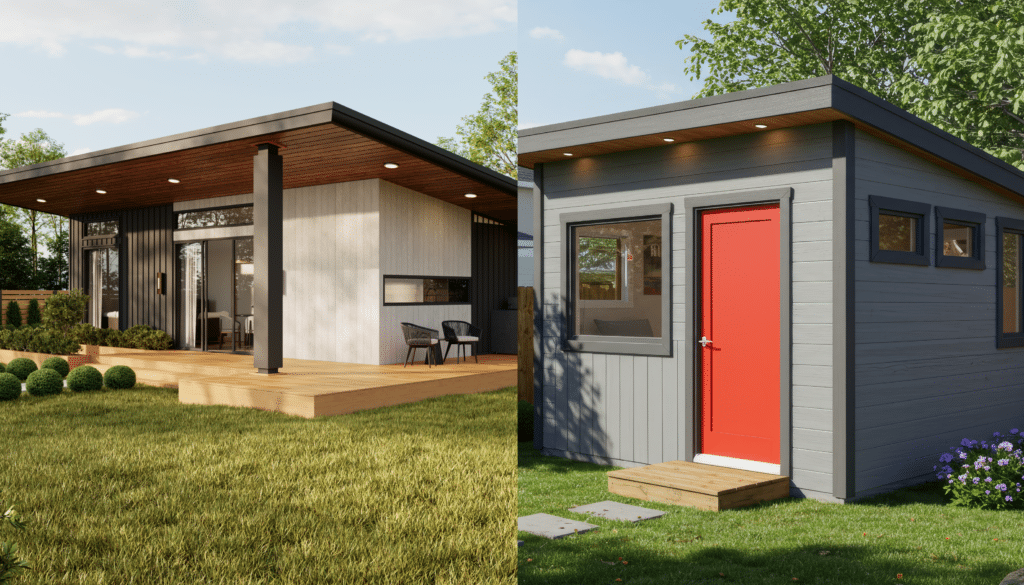
How it works: A kit home is exactly what it sounds like. Your house arrives as a kit of pre-cut components ready for assembly. Think of it as adult-sized furniture from IKEA, except it’s a dwelling instead of a bookshelf, and the instructions are considerably more complex.
The manufacturer cuts all the major components (framing, wall panels, roof sections) in a factory according to precise specifications. These components are then delivered to your property in portable sections where they’re assembled on-site. Some kits include just the structural elements whilst others provide more complete packages, but most kit homes require significant on-site construction work to reach completion.
The appeal: Cheapest upfront price.
The reality:
- You’re paying for materials only
- Still need to pay for: site prep, foundations, installation labour, internal fittings, plumbing, electrical, paint, council fees
- That $90k kit? Easily becomes $160k by the time you can actually move in
- Weather stops work constantly
- Quality depends entirely on who’s assembling it
Who it’s actually good for: Owner-builders with serious construction experience and 6+ months of free time. Not families who just want somewhere to live.
Modular Homes: Fast, Consistent, Pricier
How it works: Modular homes take prefabrication much further. Rather than delivering components for assembly, manufacturers construct entire modules (essentially complete sections of a dwelling) inside factory environments. These modules arrive at your property 80-90% finished, with walls, roofing, flooring, internal linings, windows, doors, and often even plumbing and electrical work already completed.
On your property, these modules are craned into position onto pre-prepared foundations, connected together, and linked to site services. What would take months of on-site construction in traditional building or kit home approaches can be completed in days once the modules arrive. The entire process from factory to move-in-ready might span just 12-16 weeks.
The appeal: Speed and quality control.
The reality:
- What you see is what you get (price-wise)
- Weather never delays construction
- Factory quality control means fewer defects
- Installation takes days, not months
- Design changes after factory work starts? Nearly impossible
Who it’s actually good for: Families who need housing NOW. People who value consistency over endless customisation.

Granny Flats: The Smart Investment (Here’s Why)
Here’s where terminology gets interesting. A granny flat isn’t a construction method. It’s a dwelling type. Granny flats are self-contained secondary dwellings built on properties that already have a main residence. They can be constructed using traditional on-site methods, modular construction, or even kit home approaches.
What defines a granny flat is its purpose and regulatory status, not how it’s built. In Victoria, granny flats (officially termed “small second dwellings”) up to 60 square metres don’t require planning permits in most areas, which dramatically simplifies the approval process. They must include kitchen, bathroom, and toilet facilities, and unlike previous regulations, anyone can live in them (family members, tenants, or anyone else).
This regulatory distinction matters enormously. When you build a granny flat, you’re adding a complete, independently functional living space that can serve multiple purposes over decades. Today’s student accommodation becomes tomorrow’s rental property generating passive income, then later transforms into comfortable accommodation for aging parents. This flexibility makes granny flats investments rather than just construction projects.
You can build a granny flat using:
- Traditional on-site construction (maximum customisation)
- Modular methods (speed + quality)
- Hybrid approaches (best of both)
The numbers that matter:
- Melbourne granny flat rental returns: $350-$450 per week
- Build cost: $190,000 (Innovista Affordable 60 Signature, fully inclusive)
- Payback period through rent: 8-10 years
- Value after that: Pure profit OR cost-free family accommodation
A well-built granny flat isn’t an expense. It’s an asset that adapts to your changing needs whilst adding serious property value.
Pod Homes: Stylish Offices, Not Really Homes
Let’s be honest. “Pod home” is mostly marketing speak. Most pod homes are actually small modular buildings marketed with emphasis on their compact, self-contained nature and often their sustainable design features.
What distinguishes pod homes from other modular buildings is usually their size (typically smaller), their aesthetic (often contemporary and minimalist), and their intended uses (frequently offices, studios, or guest accommodation rather than primary residences). Many pod homes feature high-quality finishes, double-glazed windows, and energy-efficient systems as standard, positioning them as premium small-space solutions.
The confusion: Some pods CAN be used for accommodation, but then they’re basically just small granny flats and need the same approvals.
What they’re genuinely good for:
- Backyard home offices
- Art or music studios
- Yoga/wellness retreats
- Guest rooms (occasional use)
What they’re NOT ideal for: Year-round living accommodation. They’re typically smaller, may lack full kitchen facilities, and aren’t designed for the rigours of daily residential use.
The Real Cost Breakdown (No BS)
Understanding true costs requires looking beyond initial quotes to total project expenses.
Kit Home Reality Check:
- Quote: $90,000
- Site prep: +$15,000
- Installation labour: +$25,000
- Internal finishing: +$20,000
- Council fees/permits: +$5,000
- Actual total: $155,000+
A kit home might quote at $90,000-$140,000, but that typically excludes site preparation, council fees, installation labour, interior finishing, and service connections. Your actual cost to move-in-ready often exceeds $150,000 once all these elements are factored in.
Modular Home Reality:
- Quote: $150,000
- Includes: Permits, installation, most finishes
- Site prep (separate): +$10,000
- Actual total: $160,000
Modular homes quote higher upfront (perhaps $120,000-$180,000) but these quotes typically include far more. Installation, many fittings and finishes, and sometimes even permit management are bundled into the price. The gap between quoted price and final cost is much narrower, providing budget certainty that kit homes can’t match.
Granny Flat (Purpose-Built):
- Quote: $190,000 all-inclusive (Innovista example)
- Includes: Everything. Permits, engineering, connections, premium inclusions
- Hidden costs: None
- Actual total: $190,000
- Annual rental income potential: $18,000-$23,000
Granny flats built by purpose-built specialists using either traditional or modular methods typically range from $150,000-$250,000 depending on size, inclusions, and finishes. This represents complete, move-in-ready dwellings with quality fixtures, proper insulation, and construction that will last decades. When you consider that Melbourne rental returns for granny flats run $350-$450 per week, these investments often pay for themselves within 7-10 years through rental income alone.
The value equation also includes what happens after construction. A well-built granny flat adds significant property value, generates rental income, or provides cost-free accommodation for family members. A kit home that was assembled inadequately or a cheap modular unit that starts showing problems after a few years may cost less initially but delivers questionable long-term value.
Which One Should You Actually Choose?
Choose a granny flat if:
- You need proper living accommodation (not just a workspace)
- You want rental income options
- Your family situation might change (students, elderly parents, adult kids)
- You’re investing in your property long-term
Choose modular construction if:
- You’re time-poor and need housing FAST
- You value quality consistency
- You’ve got a straightforward design in mind
Choose a kit home if:
- You’re an experienced owner-builder with 6+ months free
- You genuinely enjoy construction projects
- You’ve got realistic expectations about hidden costs
Choose a pod if:
- You need a workspace, not a home
- You want something small and stylish
- You’re not planning on sleeping there regularly
What Most Melbourne Families Actually Need
Here’s what we see: most families think they’re choosing between different products. They’re not.
They’re choosing what purpose they need the space to serve.
Need somewhere your daughter can live whilst studying at Monash? That’s a granny flat (regardless of how you build it).
Need a quiet office away from the kids? That’s a pod or studio.
Need emergency accommodation for aging parents being discharged from hospital in six weeks? That’s a modular granny flat.
The construction method is just the HOW. Figure out the WHY first.
The Granny Flat Advantage Nobody Talks About
Victoria’s planning regulations changed everything. Granny flats up to 60m² don’t need planning permits in most areas. This means:
- Faster approvals
- Lower permit costs
- Less regulatory headache
- More flexibility in how you use the space
No other backyard building type gets these advantages. Not kit homes. Not pods. Only granny flats designed as self-contained dwellings.
That regulatory support makes granny flats the smartest choice for anyone needing actual living space, whether you build using modular methods, traditional construction, or hybrid approaches.
Speak with our team at Innovista Group. We’ll help you figure out what you actually need (not just what we want to sell you). Sometimes that’s a granny flat. Sometimes it’s not. Either way, you’ll make the right decision for your family.


