

Most Australians assume downsizing means selling the family home and buying something smaller. However, a growing number of Melbourne retirees are discovering a superior alternative: build a modern granny flat in their backyard, move into it, and rent out the main house for substantial income.
This reverse downsizing strategy lets you stay on familiar property whilst generating $25,000-$35,000 annual rental income, maintaining capital growth potential, and avoiding the transaction costs of selling and buying. Moreover, you’re living in a brand-new, energy-efficient dwelling designed for single-level, low-maintenance retirement living.
Here’s your complete guide to downsizing to a granny flat in Melbourne, covering financial benefits, Centrelink implications, design considerations, and whether this strategy suits your retirement goals.
Why Traditional Downsizing Often Disappoints
Before exploring the granny flat alternative, understand why conventional downsizing frequently falls short of expectations.
The Traditional Downsizing Path
Standard approach: Sell the large family home, purchase a smaller property (apartment, townhouse, or smaller house), bank the difference.
Expected benefits:
- Reduced maintenance and upkeep
- Lower running costs (rates, utilities)
- Cash release for retirement funding
- Simpler, easier lifestyle
Why It Often Fails to Deliver
Transaction costs devastate returns: Selling a $850,000 home and buying a $600,000 apartment doesn’t leave you with $250,000:
- Real estate agent fees (2-2.5%): -$17,000-$21,250
- Conveyancing (both properties): -$3,000-$5,000
- Moving costs: -$2,000-$5,000
- Stamp duty on new purchase: -$31,070
- Renovation/modification costs: -$10,000-$30,000
- Net cash after transaction costs: $168,000-$196,000 (not $250,000)
Emotional disconnection: Leaving familiar neighbourhoods, established social networks, and decades of memories creates unexpected emotional challenges many retirees underestimate.
Apartment disappointments: Body corporate fees ($3,000-$8,000 annually), special levies, noisy neighbours, limited outdoor space, and lack of control disappoint many downsizers.
Loss of capital growth: You’ve sold an established house in a familiar area with proven capital growth. Your new property’s growth potential is uncertain.
Moving stress: Relocating decades of possessions creates enormous stress, particularly for older Australians.
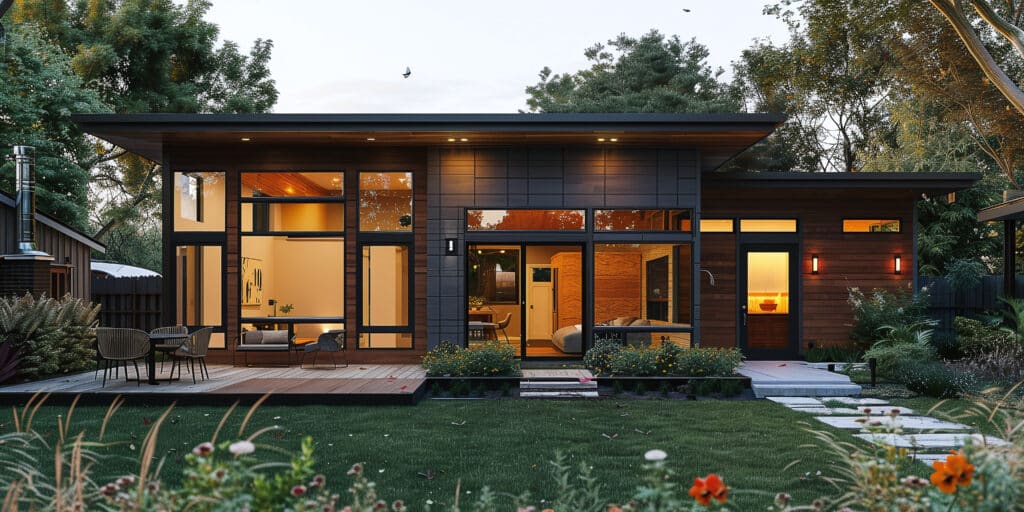
The Granny Flat Reverse Downsizing Strategy
Instead of selling and moving, build a granny flat, move into it, and rent your main house.
How It Works
Step 1: Build a modern granny flat in your backyard (typically Lana 43 or Affordable 60)
Investment: $190,000-$255,000 depending on model and specifications
Timeline: 16-20 weeks from approval to completion
Step 2: Move into the granny flat as your primary residence
Lifestyle: Modern, single-level, low-maintenance living designed for retirement
Benefits: Energy-efficient, accessible, new appliances and systems
Step 3: Rent your main house to tenants
Income: $25,000-$35,000+ annually (Melbourne 3-4 bedroom houses)
Management: Professional property managers handle everything
Capital growth: You retain ownership and benefit from continued property appreciation
Financial Comparison Table
| Strategy | Upfront Cost | Annual Income Generated | Capital Growth Retained | Transaction Costs | Emotional Connection |
|---|---|---|---|---|---|
| Traditional Downsizing | $31,070 stamp duty + $25,000-$30,000 transaction costs | $0 (lump sum only) | Lost (sold original property) | High ($50,000-$60,000 total) | Lost (new location) |
| Granny Flat Downsizing | $190,000-$255,000 construction | $25,000-$35,000+ annually | Fully retained | Minimal ($0) | Maintained (same property) |

Financial Benefits of Granny Flat Downsizing
The numbers reveal why this strategy outperforms traditional downsizing for many retirees.
Income Generation
Main house rental income: $480-$650 weekly depending on property size and location
Annual gross income: $24,960-$33,800
Less expenses:
- Property management (8%): -$2,000-$2,700
- Landlord insurance: -$1,200-$1,800
- Maintenance provision: -$2,000-$3,000
- Net annual income: $19,760-$26,300
This ongoing income supplements your retirement funding far more effectively than a one-time cash lump sum from traditional downsizing.
Capital Growth Retention
You maintain ownership of your original property, benefiting from Melbourne’s long-term capital growth (historically 6-8% annually).
10-year capital growth example (starting value $850,000):
- Year 1: $850,000
- Year 5: $1,147,000 (6% annual growth)
- Year 10: $1,549,000 (6% annual growth)
- Capital gain: $699,000 over 10 years
Traditional downsizing forfeits this growth on your original property, betting instead on a smaller, unfamiliar property’s appreciation potential.
Transaction Cost Avoidance
| Cost Type | Traditional Downsizing | Granny Flat Strategy | Savings |
|---|---|---|---|
| Agent fees (sale) | $17,000-$21,250 | $0 | $17,000-$21,250 |
| Stamp duty (purchase) | $31,070 | $0 | $31,070 |
| Conveyancing (both) | $3,000-$5,000 | $0 | $3,000-$5,000 |
| Moving costs | $2,000-$5,000 | Minimal ($500-$1,000) | $1,500-$4,000 |
| Modifications/renos | $10,000-$30,000 | $0 | $10,000-$30,000 |
| Total savings | – | – | $62,570-$91,320 |
These savings alone cover 25-48% of granny flat construction costs.
Equity Access Without Selling
Build the granny flat using existing home equity without selling:
Example: $850,000 property with $200,000 remaining mortgage
- Current equity: $650,000
- 80% LVR allows: $680,000 total lending
- Available for granny flat: $480,000 (more than sufficient for $190,000-$255,000 construction)
You access capital without selling, avoiding transaction costs whilst retaining the asset.
Tax Advantages
Main house becomes investment property: Once you move into the granny flat as your primary residence, your main house becomes an investment property eligible for:
- Depreciation deductions on existing building and fixtures
- Full deductibility of all expenses (management, insurance, maintenance, interest)
- Negative gearing benefits if expenses exceed income
Granny flat is your primary residence: As your main residence, the granny flat avoids CGT when you eventually sell (though proportional CGT would apply to the former main house).
Tax advantage example (combined income $80,000, 32.5% bracket):
- Annual expenses on main house: $15,000
- Annual rental income: $28,000
- Taxable rental income: $13,000
- Tax payable: $4,225
- But depreciation deductions: -$8,000
- Revised taxable income: $5,000
- Revised tax: $1,625
- Tax benefit from depreciation: $2,600 annually

Centrelink and Age Pension Implications
Understanding how this strategy affects Age Pension eligibility is critical for retirement planning.
Assets Test Considerations
Property value: Your property (main house + granny flat combined) counts as an asset under the assets test, but your primary residence (the granny flat you’re living in) is exempt.
Complex calculation: The former main house (now rented) becomes an investment asset. However, this is complex and depends on when you moved, how long you rent it, and your specific circumstances.
Professional advice essential: The Age Pension assets test is nuanced. Consult a financial adviser specializing in Centrelink before implementing this strategy.
Income Test Considerations
Rental income counts: Income from renting your main house counts as assessable income under the income test, potentially reducing Age Pension payments.
Deemed income rules: Centrelink applies deeming rates to financial assets but actual income for rental properties.
Income test calculation (single person):
- Full pension cut-off: $2,243.60 per fortnight ($58,334 annually including deemed investment income)
- If your rental income plus other income exceeds thresholds, pension reduces $0.50 per dollar over the threshold
Example scenario:
- Rental income: $28,000 annually
- Other income (super pension): $15,000
- Total assessable income: $43,000
- Likely outcome: Partial Age Pension eligibility
Working with Centrelink Rules
12-month principal home exemption: When you move from your main house to the granny flat, Centrelink allows a 12-month exemption period where the former main house isn’t counted as an asset, giving you time to decide your strategy.
Genuine home change: Ensure your move to the granny flat is genuine (change drivers license, electoral roll, mail redirection) to establish it as your primary residence.
Professional financial advice: Before proceeding, consult a financial adviser who specializes in Centrelink rules to model your specific circumstances and understand exact pension implications.
Lifestyle Benefits of Granny Flat Living
Beyond financial advantages, living in a modern granny flat offers significant lifestyle improvements.
Modern, Single-Level Living
Accessibility: No stairs, level entry, wide doorways, and accessible bathroom design suit aging mobility needs.
Energy efficiency: Double-glazed windows, superior insulation, and heat pump systems create comfortable living whilst reducing utility bills 30-50% compared to older main houses.
Modern systems: Brand-new heating, cooling, hot water, and appliances eliminate maintenance headaches and breakdowns common in older properties.
Low maintenance: Compact design, durable materials, and new construction require minimal upkeep compared to aging main houses.
Simplified Living
Downsized possessions: Moving to 43-60m² forces decluttering decades of accumulated possessions, simplifying life and reducing maintenance burden.
Lower running costs: Smaller space means lower heating/cooling costs, less cleaning, reduced maintenance, and simplified housekeeping.
Security: Compact, secure granny flats with modern locks and often positioned away from street frontage provide enhanced security.
Familiar Environment Maintained
Same neighbourhood: Stay connected to established social networks, familiar doctors, shops, community groups, and friends.
Same garden: Maintain connection to your garden (though tenants handle most maintenance) and familiar outdoor spaces.
Emotional continuity: Avoid the emotional trauma of leaving the family home whilst still achieving practical downsizing.
Flexibility for Visitors
Main house for family visits: When children and grandchildren visit, they can stay in the main house (when between tenants) or if you arrange shorter leases, providing space without crowding your granny flat.
Hosting capacity: Unlike apartments with limited guest space, you maintain hosting capacity through your property’s main house.
Design Considerations for Retiree Granny Flats
Choosing the right granny flat design maximizes retirement living comfort.
One Bedroom vs Two Bedroom
Lana 43 (One bedroom, 43m²):
- Best for: Single retirees or couples comfortable with compact living
- Benefits: Lower construction costs ($230,000-$245,000), easier maintenance
- Considerations: Limited guest accommodation, less storage
Affordable 60 or Lana 60 (Two bedrooms, 60m²):
- Best for: Couples wanting separate spaces or occasional guest accommodation
- Benefits: Second bedroom for guests/hobbies/office, more storage, spacious living
- Investment: $190,000-$255,000 depending on specification
Accessibility Features
Level entry: Zero-step entry from outdoors to inside (standard in Innovista designs)
Wide doorways: Minimum 820mm door widths accommodate mobility aids if needed in future
Accessible bathroom: Hobless shower entry, grab rail provisions, adequate circulation space
Single-level living: Everything on one floor eliminates stairs entirely
Future-Proofing
Grab rail reinforcement: Walls reinforced in bathrooms for future grab rail installation if needed
Wider circulation: Hallways and room transitions designed for mobility aid access
Universal design: Light switches, power points, and controls at accessible heights
Tax Implications and Financial Planning
Capital Gains Tax (CGT) Considerations
Main residence exemption: When you sell the entire property (years down the track), CGT calculations become complex:
- Your granny flat maintains main residence exemption (no CGT)
- Your former main house (rented out) will have proportional CGT based on the period it was rented versus owner-occupied
Example:
- Owned property 30 years total
- Lived in main house 25 years (owner-occupied)
- Rented main house 5 years (investment)
- Capital gain: $700,000
- CGT applies proportionally to rental period: 5/30 = 16.67% of capital gain
- CGT payable on: $116,667 (50% discount applies if held 12+ months)
Income Tax on Rental Income
Rental income is taxable, but expenses are deductible:
- Property management fees
- Landlord insurance
- Repairs and maintenance
- Interest on loans (if borrowed for granny flat construction)
- Council rates
- Depreciation on building and fixtures
Net effect: Many retirees find actual tax payable on rental income is minimal after claiming all legitimate deductions.
Professional Financial Advice Essential
This strategy involves complex interactions between:
- Centrelink Age Pension rules
- Capital Gains Tax calculations
- Income tax on rental income
- Assets test implications
- Estate planning considerations
Recommendation: Engage a financial adviser specializing in retirement planning and a tax accountant experienced with property investment before proceeding.
When Granny Flat Downsizing Makes Sense
This strategy suits specific retiree circumstances.
Ideal Candidates
Adequate land: Properties with 600m²+ blocks easily accommodate granny flats whilst maintaining main house appeal to tenants.
Emotional attachment: You love your neighbourhood, social connections, and community but find your home too large or maintenance-intensive.
Capital constrained: You need retirement income but don’t want to sell your property and lose capital growth potential.
Healthy and mobile: You’re currently healthy enough to live independently in a compact space (though accessibility design provides future flexibility).
Long-term horizon: You plan to stay in the area for 10+ years, making the construction investment worthwhile.
Family nearby: Local children or grandchildren mean staying in the area maintains family connections.
When Traditional Downsizing Is Better
Relocation desired: You want to move to a different area (beach, regional town, closer to family in another city).
Landlord aversion: You don’t want any involvement in property management or tenant relationships, even with professional managers handling everything.
Lump sum needed: You require a significant cash injection for specific purposes (health costs, aged care bond) that rental income can’t provide quickly enough.
Small block: Properties under 450m² may not accommodate granny flats whilst maintaining main house appeal and complying with council requirements.
Health concerns: Significant health issues requiring higher care levels may make independent granny flat living unsuitable.
The Bottom Line: Granny Flat Downsizing
For Melbourne retirees with adequate land, strong neighbourhood connections, and desire for ongoing income rather than lump sums, downsizing to a granny flat delivers compelling advantages:
Financial: Generate $19,760-$26,300 annual net income whilst retaining full property ownership and capital growth potential. Avoid $62,570-$91,320 in transaction costs associated with traditional downsizing.
Lifestyle: Live in modern, energy-efficient, accessible, single-level accommodation whilst maintaining emotional connection to your property and neighbourhood.
Flexibility: Retain options to reverse the strategy, sell the entire property later, or adjust arrangements as circumstances change.
Estate planning: Preserve valuable property asset for estate planning whilst generating income during retirement.
This reverse downsizing strategy won’t suit everyone, but for the right circumstances, it delivers superior financial and lifestyle outcomes compared to traditional sell-and-relocate downsizing.
Contact Innovista Group to discuss granny flat options designed for retirement living, including accessibility features, energy efficiency, and low-maintenance designs.


